



Tarmac to Truck in Under an Hour: Designing an Airport Pickup SOP for Temp-Sensitive Cargo
6 May 2026

For temperature-sensitive cargo, the airport handoff is often the most fragile part of the journey. The product may have traveled internationally under tightly controlled conditions, only to face its highest exposure risk after landing: time on the apron, customs delay, terminal congestion, or a truck that is not truly ready when release comes through.
That is why an airport pickup SOP matters. The goal is not just to “pick up fast.” It is to move cargo from airside release into a qualified temperature-controlled road leg with as few uncontrolled minutes as possible. WHO guidance for time- and temperature-sensitive products says shipments should be removed from the airport apron as soon as possible and placed into a safe temperature-controlled location, and that customs procedures should be designed to clear these shipments rapidly to avoid temperature excursions.
An “under an hour” target is not a regulation. It is an operational benchmark. For many temp-sensitive shipments, it is a smart one, because airport risk increases every time the cargo waits in the wrong environment or sits between handoffs without clear control. IATA’s temperature-control framework reflects that same logic: temperature-sensitive healthcare cargo should be handed over on a temperature-controlled truck set at the correct temperature range shown on the Air Waybill.
What a strong airport pickup SOP should include
A workable SOP starts before wheels-down. First, the truck, driver, shipment documents, temperature range, release contacts, and airport access steps should all be confirmed in advance. WHO recommends using a port of entry equipped to handle temperature-sensitive products and, where needed, putting procedures in place for rapid customs clearance or pre-clearance to reduce excursion risk.
Second, the road equipment must be ready, not merely available. That means the correct reefer unit, the correct setpoint, and a vehicle qualified for temperature-controlled transport. WHO guidance says temperature-controlled road vehicles should be qualified to show they can maintain required conditions across expected ambient extremes, and that transport temperature-monitoring devices should be calibrated and alarm functionality checked and recorded.
Third, the handoff has to be controlled. A good SOP should define who receives the release notice, who confirms customs status, who verifies the shipment label and Air Waybill temperature range, who checks packaging condition, and who authorizes loading into the truck. IATA’s temperature-control requirements and CEIV Pharma framework emphasize documentation, infrastructure and equipment, temporary storage, ground transportation, tarmac transportation, and acceptance procedures as critical control points.
Fourth, the move needs live visibility and a contingency plan. WHO guidance calls for documented and tracked deliveries, signed dispatch and arrival records, GPS-based security where appropriate, and action plans for breakdowns or temperature excursions. FDA’s sanitary transportation rule makes the same principle clear for food: transportation practices must prevent risks such as failure to properly refrigerate and failure to protect the product during transit.
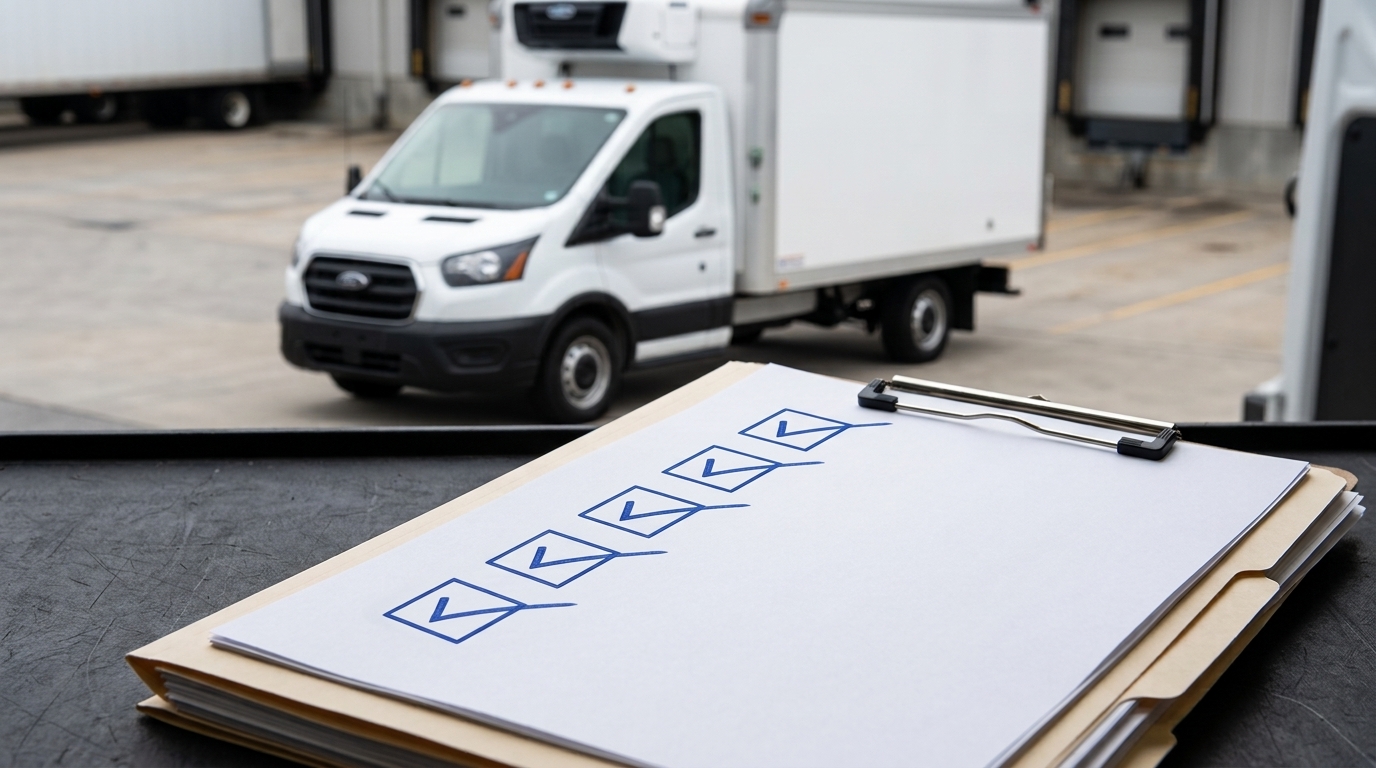
In practice, that means a strong airport pickup SOP usually includes these steps:
- pre-alert and document review before landing;
- confirmed release workflow with customs or handling agent;
- pre-positioned reefer vehicle set to the correct temperature;
- shipment identity and label verification at handoff;
- immediate loading into qualified temperature-controlled equipment;
- real-time GPS and temperature monitoring from departure;
- escalation steps for delay, refusal, breakdown, or excursion.
How Reefer Van Network solves the problem
RVN supports direct airport pickups with pre-arranged access and coordination, which matters because temp-sensitive freight usually fails in the gaps between parties, not in the moments when everyone is actively watching it. Our process starts before release: shipment details, handling instructions, temperature requirements, and pickup timing are aligned in advance so the truck is not being sourced after the cargo is already waiting.
We also solve the equipment problem. Airport pickups are often too urgent, too small, or too urban for a full trailer to be the best option. RVN’s fleet model includes reefer vans, box trucks, and straight trucks that can be deployed for short-haul airport transfers and final-mile temperature-controlled moves. These smaller units are built for faster turnarounds at airport cargo facilities and are better suited to tight loading zones and quick recovery of urgent freight.
Visibility is the next layer. Through the RVN Customer Portal, customers can quote, book, and track shipments in one place, with real-time GPS updates and detailed trip information. That matters at the airport because once a shipment leaves the cargo facility, the next question is immediate: Is it moving, and is it moving correctly? RVN’s portal is designed around instant estimates, guaranteed pickup booking, and real-time shipment tracking, supported by 24/7 operations.
Just as important, we do not treat airport pickup as a simple truck dispatch. We treat it as a controlled temperature-sensitive handoff. That means matching the vehicle to the shipment, coordinating pickup timing around release, maintaining visibility from first movement, and supporting the move with a team that understands regulated freight and exception response. In a setting where apron time, customs delay, or one missed communication can compromise the load, that operating model matters more than raw capacity.
Wrap-up
For temp-sensitive cargo, airport pickup should never be treated as an afterthought. It is a high-risk transfer point that needs its own SOP: pre-clear the paperwork, pre-position the reefer, verify the temperature range, minimize apron exposure, document the handoff, and keep the load visible from the first road mile. WHO, IATA, and FDA guidance all point in the same direction: control the handoff, control the environment, and control the response if something changes.
Reefer Van Network helps customers do exactly that. We turn the airport handoff from a weak point into a managed, temperature-controlled transfer designed for speed, visibility, and product protection.
Back to blogYou may also be interested in
Reefer Breakdown Recovery and Chain of Custody
Why recovery has to protect both the freight and the record of what happened A reefer breakdown changes more than the transportation plan. Once temperature control or vehicle movement is disrupted, the recovery process has to protect the freight while preserving a clear record of who controlled it, where it moved, and what conditions surrounded […]

Temperature Mapping Inside a Refrigerated Box Truck
How a Spatial Temperature Profile Supports Vehicle Qualification and Loading Decisions Temperature mapping turns the interior of a refrigerated box truck into a measured space. Instead of evaluating the vehicle from one temperature location, the exercise identifies where the payload area tends to run hottest, coldest, or otherwise requires closer attention under defined test conditions. […]